Treatment of varicose veins using HIFU ultrasound therapy: an innovative and non-invasive solution
Varicose veins and chronic venous insufficiency affect a large number of patients and can lead to bothersome symptoms such as heavy legs, pain, nighttime cramps, or swelling of the lower limbs. Today, HIFU (High-Intensity Focused Ultrasound) ultrasound therapy for varicose veins represents a promising advancement in the management of certain forms of venous insufficiency. This technique uses high-intensity focused ultrasound to treat the diseased vein without incisions, catheters, or major surgery. There is no longer a need for an operating room or anesthesia.
What is HIFU echotherapy for varicose veins?
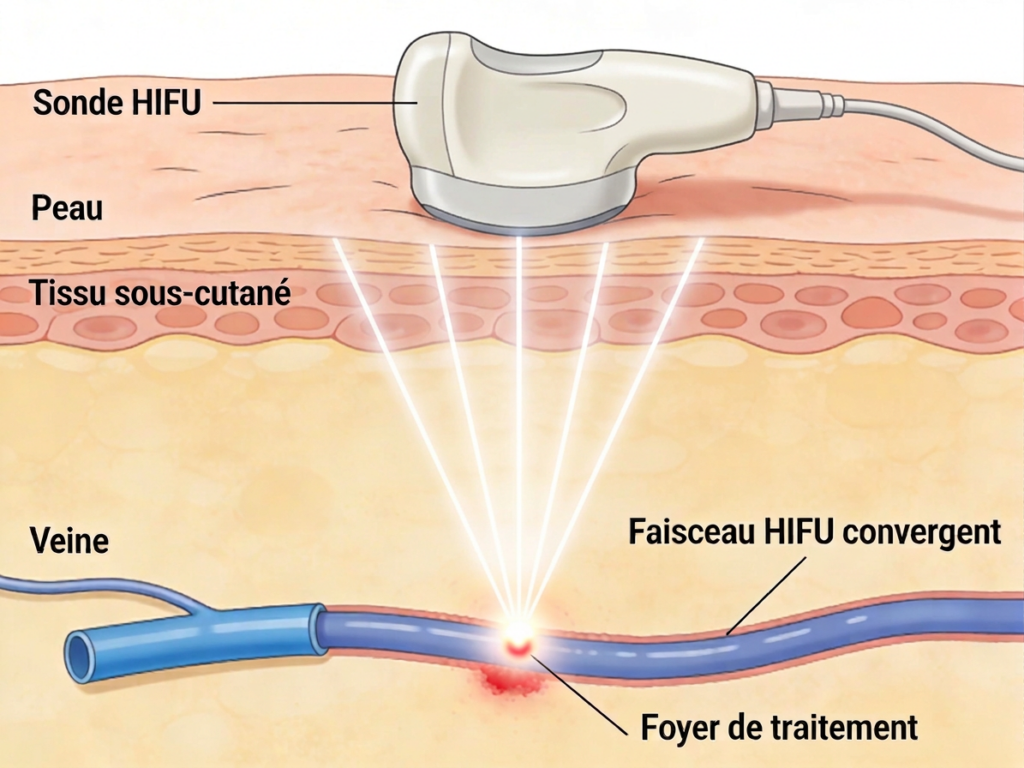
HIFU echotherapy, for High Intensity Focused Ultrasound, is based on a simple principle: to concentrate high intensity ultrasound on a precise area of the vein to be treated in order to cause its progressive closure and eliminate reflux in the vein (venous insufficiency).
Energy is delivered through the skin, under ultrasound guidance, which allows the vein to be targeted with precision.
Unlike endovenous laser or radiofrequency ablation, this method is non-invasive. This means that it is not necessary to insert a fiber or probe into the vein. The treatment is therefore more comfortable for some patients and can minimize local after-effects.
How does HIFU treatment for varicose veins work?
Treatment begins with a complete venous assessment, particularly a Doppler ultrasound, which is essential for analyzing the venous network, identifying affected veins, and checking for venous reflux. This examination confirms the need for treatment and allows for the development of the most appropriate therapeutic strategy.
During the session, the doctor locates the target vein using ultrasound. Focused ultrasound waves are then applied with great precision to the affected area. This energy creates localized heating, resulting in a controlled closure of the vein. The vein no longer performs its pathological function and is then gradually reabsorbed by the body.
The procedure is performed without incision, scarring, or the insertion of any instrument into the vein. It is therefore a modern approach to treating venous insufficiency, particularly beneficial in certain carefully selected cases.
The procedure takes place in the surgeon’s office without anesthesia and without going to the operating room. Normal activities can be resumed immediately afterward.
What are the benefits of HIFU treatment for varicose veins?
One of the main advantages of HIFU echotherapy is its non-invasive nature. This technique offers an attractive alternative to conventional endovenous treatments, while maintaining good targeting accuracy thanks to ultrasound guidance.
The potential benefits of HIFU treatment for varicose veins are numerous:
• absence of surgical incision;
• no venipuncture or catheter;
• targeted treatment under ultrasound guidance;
• often simple sequences;
• rapid resumption of daily activities;
• aesthetic appeal with few or no visible traces;
• Increased comfort for some patients.
In selected patients, this technique can meet a growing demand for effective, less invasive and better tolerated treatment.
For which patients can HIFU be offered?
HIFU treatment for varicose veins is not suitable for all patients. It may be considered in certain situations of venous insufficiency with well-identified venous reflux, particularly when the diseased vein is accessible by ultrasound and the anatomy is suitable.
The choice of treatment depends on several factors: the location of the varicose veins, the diameter of the veins, the symptoms experienced, the patient’s medical history, and their goals. In some cases, other techniques such as sclerotherapy, endovenous laser ablation, or radiofrequency ablation may be more suitable. A specialist consultation with a vascular surgeon is therefore essential to determine the best treatment option.
HIFU and venous insufficiency: a modern approach
Chronic venous insufficiency is a progressive disease that can impair quality of life. When the venous valves malfunction, blood has difficulty returning to the heart and stagnates in the superficial veins. This poor circulation promotes the development of varicose veins, feelings of heaviness, and sometimes more serious complications.
HIFU echotherapy offers a modern therapeutic solution to this problem. By treating the vein responsible for the reflux, it corrects the problem at its source, while minimizing damage to surrounding tissues. It is this combination of precision, comfort and non-invasiveness that explains the growing interest in this technique.
Follow-up and recovery after HIFU treatment
In most cases, the after-effects of HIFU treatment are simple. The patient can often resume their usual activities quickly, with recommendations tailored to the clinical context. However, medical monitoring remains necessary to assess progress and confirm the effectiveness of the treatment. A post-operative visit is required one week after the procedure. In certain cases, preventive anticoagulant treatment may be prescribed.
As with any venous care, personalized follow-up is essential in order to adapt the treatment to the evolution of symptoms and the anatomical response observed on ultrasound.
In summary
The treatment of varicose veins by HIFU echotherapy represents an important innovation in the management of venous insufficiency. Thanks to high-intensity focused ultrasound, it is possible to treat certain insufficient veins precisely, without incision and without catheter. This non-invasive technique is appealing because of its comfort, simplicity and aesthetic appeal, while remaining a solution to be reserved for well-selected indications.
To determine if HIFU echotherapy is suitable for your situation, a specialized venous assessment remains essential.
Dr. Guilhem Seban, a vascular surgeon in Annemasse, practices the treatment of venous insufficiency by echotherapy.